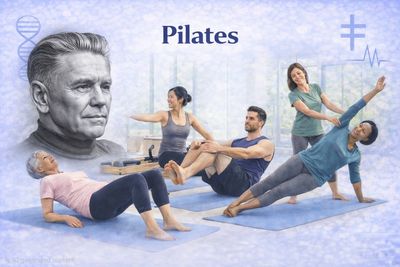
Joseph Pilates developed Pilates in the early 1900s. He was born in Germany in 1883 and had a difficult childhood, reportedly dealing with asthma, rickets and rheumatic fever. Because of this, he became fascinated by movement, anatomy, breathing and physical conditioning, spending years studying gymnastics, martial arts, yoga, boxing and different forms of exercise.
During World War I, Joseph Pilates was living in England. As a German national he was interned and later worked in a hospital setting as an orderly, helping care for injured and unwell patients. While working with patients who were confined to beds, he began attaching springs to hospital bed frames so they could start moving and exercising even while lying down. This idea eventually led to the creation of Pilates equipment such as the Pilates reformer.
Pilates originally designed many of the exercises for people who were weak, injured, recovering from illness or unable to tolerate more intense activity. His aim was to help people build strength safely, improve posture, support breathing, increase flexibility and restore function. Many of his original exercises focused on controlled, precise movements rather than heavy exertion.
Pilates originally called his method “Contrology” because he believed movement should be controlled by the mind, with a strong focus on concentration, breathing and body awareness. He believed that learning to move well could improve not just physical health, but also mental wellbeing and confidence.
Today, Pilates is used by people of all ages and abilities, from athletes to older adults, people recovering after illness or surgery, and those looking for gentle exercise. It is especially popular for improving:
• Core strength
• Balance and coordination
• Posture
• Flexibility
• Joint mobility
• Breathing control
• Back pain
• Confidence with movement
• Recovery after illness or treatment
For OAK clients, Pilates can be especially useful because it is gentle, adaptable and easy to start. Many exercises can be done seated, standing, on a bed or on the floor, and movements can be adjusted depending on energy levels, symptoms or treatment side effects.